
 Juliana — Sales & GTM expert
If you sell B2B software, the fastest pipeline you can build is made of companies already paying your competitor. They have budget. They've validated the problem. They know the category. Your job is no longer to educate — it's to show them why switching makes sense. This playbook shows you how, step by step.
Why does competitor intelligence change reply rates?
Generic cold outreach fails because it forces your prospect to do too much work. They have to understand who you are, what you do, whether it applies to them, and whether it's worth a reply — all in under 10 seconds.
When you target companies already using a competitor, you compress that decision. The prospect already understands your category. They've allocated budget. And if you can name their specific tool, you've demonstrated you did your homework.
"Going from 'you might be interested in this' to 'you use Salesforce, and here's exactly what we do better for your size of company' is the difference between a 2% and a 15% reply rate."
— Sales team using Stealery, series A SaaS, 45-person company
According to McKinsey research on B2B personalisation, companies that lead with contextual, buyer-specific messaging see 5–8x higher ROI on their outreach compared to generic campaigns. Competitor targeting is the highest-context signal available.
How do you find companies using your competitors?
This is the first challenge. You need to identify, at scale, which companies in your target market are actively using a specific tool. There are three approaches:
1. Job postings (most scalable)
Companies that mention a competitor's product name in job descriptions are confirmed users. A company hiring a "HubSpot Admin" is running HubSpot. This is public data, constantly refreshed, and covers millions of companies globally.
2. Competitor intelligence tools
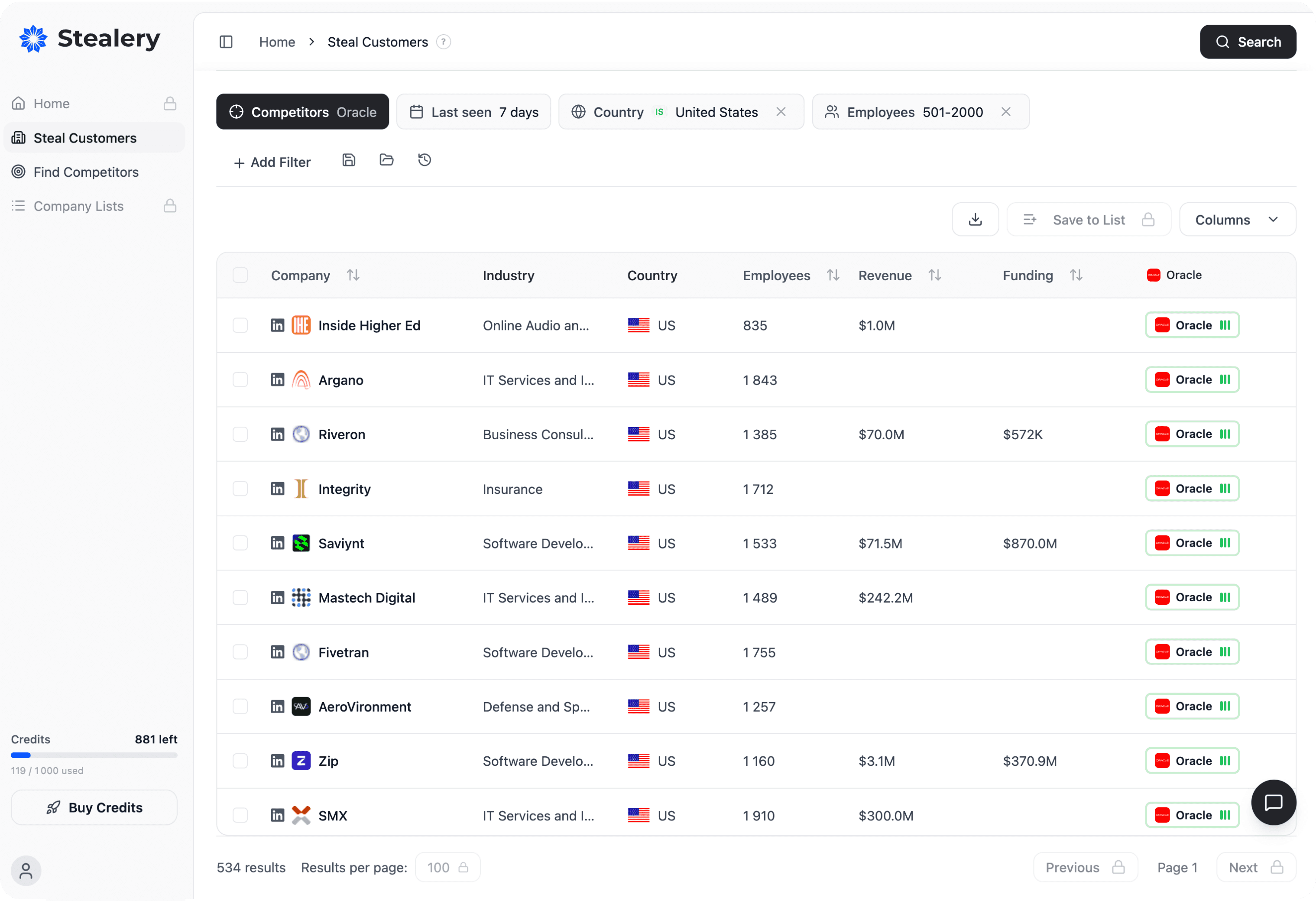
Tools like Stealery index this job data and let you search by competitor name, filter by ICP criteria, and export a list in minutes. What would take a researcher days takes under 10 minutes.
3. Manual signals
G2/Capterra reviews, LinkedIn endorsements, and tech stack trackers like BuiltWith can surface individual prospects — but not at the volume needed for a full outbound motion.
For a working outbound strategy, you need at least 200–500 qualified accounts per quarter. Option 2 is the only one that scales.
How do you understand their pain points?
Before writing a single word, you need a honest inventory of why someone would switch away from your competitor. This is where most teams stop — they assume the prospect will figure it out. They won't.
- Read the 1-3 star reviews of your competitor on G2, Capterra, or Trustpilot — that's your pain library
- Talk to churned customers from your competitor (you may already have some)
- Track what your own customers say was the reason they switched when onboarding
Map this into a tight list of 3–5 specific pains, ranked by frequency. These become your email variations.
How do you write a cold email targeting competitor users?
A competitor-intelligence cold email has one goal: show the prospect you know their exact situation, and give them one reason to reply. The structure:
- Signal — acknowledge the tool they use ("I noticed [Company] is running on HubSpot...")
- Pain — name a specific, documented frustration ("...a lot of HubSpot teams we talk to struggle with multi-touch attribution at scale")
- Hook — your specific advantage ("We built our attribution layer specifically around that gap — 3 companies your size switched last quarter")
- CTA — one low-friction ask ("Worth a 15-min call this week to see if the same applies to you?")
Keep it under 100 words. The context does the heavy lifting — the prospect immediately knows this isn't a mass blast. A study by Woodpecker found that emails under 100 words have a 51% higher reply rate than emails over 200 words.
Should you filter your list before sending outreach?
Always. A list of 200 well-qualified accounts will outperform 2,000 cold ones — both in reply rate and in conversion to pipeline. Before exporting, apply these filters:
- Company size — your ACV model defines the minimum viable employee count
- Hiring signals — companies actively hiring are in growth mode, more likely to evaluate new tools
- Geography — only send to regions your team can actually close and serve
- Industry — cut verticals where your product has no differentiation
In Stealery, these filters are built into the search — you never export a raw unfiltered list.
What results can you expect from this playbook?
Teams consistently applying competitor-based targeting report:
- 2x reply rates vs. generic cold email (median improvement across Stealery users)
- 40% shorter sales cycles — prospects don't need education, they need a reason to switch
- Higher close rates — because the ICP is pre-validated at the list-building stage, not during qualification calls
The mechanism is simple: you're not interrupting someone's day with a generic pitch. You're showing up with context, naming a real pain, and offering a specific solution. That combination is rare enough in cold outreach that it stands out every time.
Frequently asked questions
Ready to build your first competitor list?
Type in any competitor and see every company using it — filtered by size, location, and hiring signals.
Try Stealery for free →